Local search has changed dramatically over the past few years. Today, many local businesses are discovering a frustrating pattern: they rank well in Google Maps, yet fail to appear when potential customers ask ChatGPT, Google AI Overviews, or Perplexity for recommendations.
For example, a homeowner might ask:
“Who is the best emergency plumber near me?”
Instead of displaying every business that appears in Google’s Local Pack, AI-powered search engines evaluate multiple trust signals before recommending a company. One of the most fundamental—but frequently overlooked—signals is NAP consistency.
While reviews, backlinks, service pages, and Google Business Profile optimization remain essential, inconsistent business information across the web can reduce confidence in your business entity. In 2026, that affects not only traditional local rankings but also how AI systems determine whether your business deserves to be recommended.
At ROI Spectrum, we’ve seen this challenge repeatedly across local service industries—including HVAC companies, dentists, plumbers, law firms, electricians, roofing contractors, and multi-location businesses. Businesses often invest heavily in SEO while unknowingly maintaining dozens of conflicting citations across directories, social profiles, and outdated websites. These inconsistencies create uncertainty for search engines and AI systems trying to verify the same business entity.
The solution begins with understanding what NAP consistency really means—and why it has become a foundational element of both Local SEO and Generative Engine Optimization (GEO).
Key Takeaways
If there’s one lesson local businesses should carry into 2026, it’s this:
NAP consistency remains one of the quiet prerequisites for sustainable local visibility.
It may not be the most visible ranking factor, but it underpins the trust that both search engines and AI systems place in your business.
To recap:
- NAP consistency helps search engines verify your business entity.
- Consistent citations strengthen Google’s understanding of your business across the web.
- AI-powered search platforms increasingly rely on entity confidence when recommending local businesses.
- Structured data, Google Business Profile optimization, and accurate citations work together—not independently.
- NAP consistency is necessary but not sufficient; reviews, content quality, local authority, relevance, and proximity continue to play major roles.
For business owners, the practical takeaway is simple: before investing heavily in advanced SEO tactics, ensure your foundational business information is accurate everywhere your customers—and search engines—can find it.
What Is NAP Consistency?
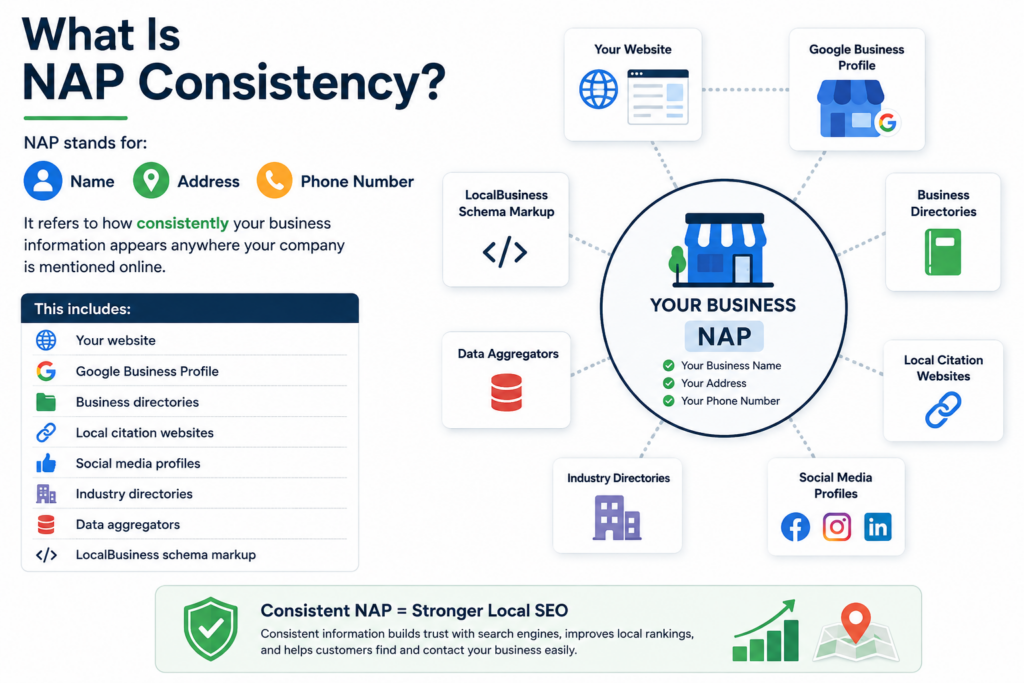
NAP stands for:
- Name
- Address
- Phone Number
It refers to how consistently your business information appears anywhere your company is mentioned online.
This includes:
- Your website
- Google Business Profile
- Business directories
- Local citation websites
- Social media profiles
- Industry directories
- Data aggregators
- LocalBusiness schema markup
Search engines compare these references to determine whether they all represent the same real-world business.
In 2026, this process extends beyond Google’s traditional algorithms. Large Language Models (LLMs) powering AI search also evaluate multiple trusted sources before generating local recommendations.
If your business appears with conflicting information, AI systems have less confidence that all those references belong to the same entity.
Why NAP Matters More Than Ever
Years ago, citation consistency was viewed primarily as a local ranking signal.
Today, it has evolved into an entity verification signal.
Modern search engines increasingly rely on semantic understanding rather than simple keyword matching. Instead of matching exact words, they attempt to understand businesses as entities connected through trusted relationships and consistent data across the web.
The Lumar Semantic Relevance SEO Report explains that modern search systems use vector embeddings, entity recognition, and Knowledge Graph relationships rather than relying solely on traditional keyword matching. Search engines now evaluate how well information aligns semantically and whether entities can be confidently identified across multiple sources.
For local businesses, that means every accurate citation reinforces your digital identity.
Every conflicting citation weakens it.
NAP Consistency Is About More Than Matching Text
Many business owners assume consistency simply means copying the same address everywhere.
The reality is more nuanced.
A consistent business profile includes alignment across:
- Business name
- Street address
- Suite numbers
- Phone number
- Website URL
- Business category
- Opening hours
- Geographic coordinates
- Schema markup
- Google Business Profile information
Together, these signals help search engines build confidence in your business entity.
When multiple authoritative sources agree, Google’s Knowledge Graph can more easily connect them into one verified business.
AI search systems perform a similar process when determining which businesses deserve inclusion in generated answers.
Exact Match vs. Acceptable Variations
One common misconception is that every citation must be character-for-character identical.
In reality, some formatting differences are perfectly acceptable.
For example:
✅ 123 Main Street
✅ 123 Main St.
Both versions typically refer to the same location.
Similarly:
- Road vs Rd.
- Avenue vs Ave.
- Suite vs Ste.
- Boulevard vs Blvd.
Search engines generally understand these standardized postal abbreviations.
However, inconsistencies become problematic when they introduce ambiguity.
For example:
- Different phone numbers
- Old addresses
- Different business names
- Missing suite numbers
- Different local area codes
- Multiple website URLs
These create uncertainty about whether citations represent the same business.
Where Your NAP Information Must Be Consistent
Many businesses only update their Google Business Profile after moving offices.
Unfortunately, Google isn’t the only place where your business exists online.
Your NAP should remain consistent across every major digital touchpoint.
Your Website
Every location should have:
- Dedicated contact page
- Footer information
- Location landing page
- LocalBusiness schema markup
- Embedded Google Map
The website serves as the primary source of truth for your business information.
Google Business Profile
Your Google Business Profile remains one of the strongest local ranking assets.
Its business name, address, phone number, categories, website URL, and operating hours should perfectly align with your website.
Google continuously compares GBP information against external citations to assess business legitimacy.
Schema.org LocalBusiness Markup
Structured data has become increasingly important for helping machines understand local businesses.
Schema allows you to explicitly define:
- Business name
- Address
- Telephone
- Geo coordinates
- Opening hours
- Service area
- SameAs profiles
Unlike visible website content, schema is designed specifically for search engines and AI systems.
When properly implemented, it reinforces entity consistency.
Major Business Directories
Authoritative directories continue to act as trust signals.
Examples include:
- Apple Business Connect
- Bing Places
- Yelp
- Yellow Pages
- Better Business Bureau
- Industry-specific directories
Search engines frequently cross-reference these sources when validating business information.
Data Aggregators
Many smaller directories don’t collect business information directly.
Instead, they receive data from large aggregators.
If incorrect information enters these databases, dozens—or even hundreds—of additional citations may inherit those errors.
That’s why professional citation management focuses on correcting the original source rather than manually editing every individual listing.
Social Profiles
Business information should also remain synchronized across:
- X
- YouTube
- Local community listings
Although social profiles may carry less direct ranking weight than primary citations, they contribute to overall entity consistency.
Multi-Location Businesses Require Separate Entities
One of the biggest mistakes we encounter involves businesses operating from multiple locations.
Each office should be treated as its own local entity.
For example, a dental practice with locations in:
- Dallas
- Fort Worth
- Plano
should maintain:
- Individual Google Business Profiles
- Dedicated location pages
- Unique LocalBusiness schema
- Separate phone numbers where appropriate
- Independent citation profiles
Combining multiple locations under a single citation often confuses search engines and weakens local visibility for every office.
Instead, each location should establish its own consistent digital footprint while remaining connected under the parent brand.
Why This Matters Beyond Traditional SEO
Historically, NAP consistency was associated with higher rankings in Google’s Local Pack and Maps 3-Pack.
That remains true.
However, today’s search landscape is broader.
Consumers increasingly ask AI assistants questions like:
- Who installs HVAC systems near me?
- Best family lawyer in downtown Chicago
- Emergency electrician open now
- Top-rated dentist accepting new patients
AI systems don’t simply copy Google’s Local Pack.
Instead, they synthesize information from multiple trusted sources, evaluate entity confidence, and recommend businesses they believe are legitimate, relevant, and authoritative.
Consistent NAP information provides the foundational trust signal that supports those recommendations.
It doesn’t guarantee visibility—but without it, every other optimization effort becomes less effective.
How NAP Consistency Influences Google Maps & Local Pack Rankings
NAP consistency has never been the only local ranking factor, but it remains one of the foundational trust signals that supports Google’s understanding of a business. In 2026, local search success depends on a combination of relevance, distance, prominence, reviews, website quality, and business information accuracy.
Think of NAP consistency as the foundation of a house. Even with excellent reviews and a well-optimized Google Business Profile (GBP), conflicting business information across the web can weaken Google’s confidence in your business entity.
Citation Consistency Supports Google’s Prominence Signals
Google evaluates local businesses using three primary concepts:
- Relevance – How closely your business matches the user’s search intent.
- Distance – How close your business is to the searcher or searched location.
- Prominence – How well-known and trustworthy your business appears online.
Citation consistency primarily strengthens the Prominence pillar.
When Google finds the same business name, address, phone number, website, and supporting details repeated consistently across trusted websites, it gains confidence that the business is legitimate and well-established.
Conversely, conflicting information forces Google to spend additional resources determining which version is correct. That uncertainty can weaken the overall trust associated with your business entity.
Recent editions of the Whitespark Local Search Ranking Factors continue to identify citation quality and business information consistency as foundational local SEO signals, even as Google Business Profile engagement, reviews, and website authority have become increasingly influential.
Why Inconsistent Citations Dilute Trust
Imagine Google discovering the following information:
| Source | Business Name | Phone Number |
|---|---|---|
| Website | ABC Plumbing | (555) 123-4567 |
| Yelp | ABC Plumbing LLC | (555) 987-6543 |
| ABC Plumbing Services | (555) 123-4567 | |
| Chamber of Commerce | ABC Plumbing | Old Address |
Individually, these discrepancies may appear minor.
Collectively, they create ambiguity.
Search engines must determine whether these citations represent:
- One business
- Multiple businesses
- A business that relocated
- An outdated listing
- A duplicate entity
Every inconsistency slightly reduces confidence.
That confidence matters not only for Google Maps but also for AI systems attempting to recommend trusted local businesses.
Consumer Trust Is A Ranking Signal Too
NAP consistency isn’t only about algorithms.
It’s about customers.
Imagine finding a law firm’s phone number through an online directory only to discover it’s disconnected.
Or driving to an old office address listed on Facebook.
These frustrating experiences reduce trust before the customer ever contacts the business.
Older—but still widely referenced—BrightLocal consumer research consistently found that inaccurate business information is a common reason consumers lose trust in local businesses and abandon their search. While the exact percentages vary by study year, the underlying finding remains consistent: inaccurate contact information negatively affects both user experience and conversion rates.
In other words, citation consistency improves both discoverability and customer confidence.
Why NAP Consistency Matters for AI Search Visibility
The rise of generative search has changed how businesses earn visibility online.
Rather than displaying a list of links, platforms such as ChatGPT, Google AI Overviews, Perplexity, and Microsoft Copilot increasingly synthesize information from multiple trusted sources before recommending businesses.
This process relies heavily on entity confidence.
AI Doesn’t Read One Website
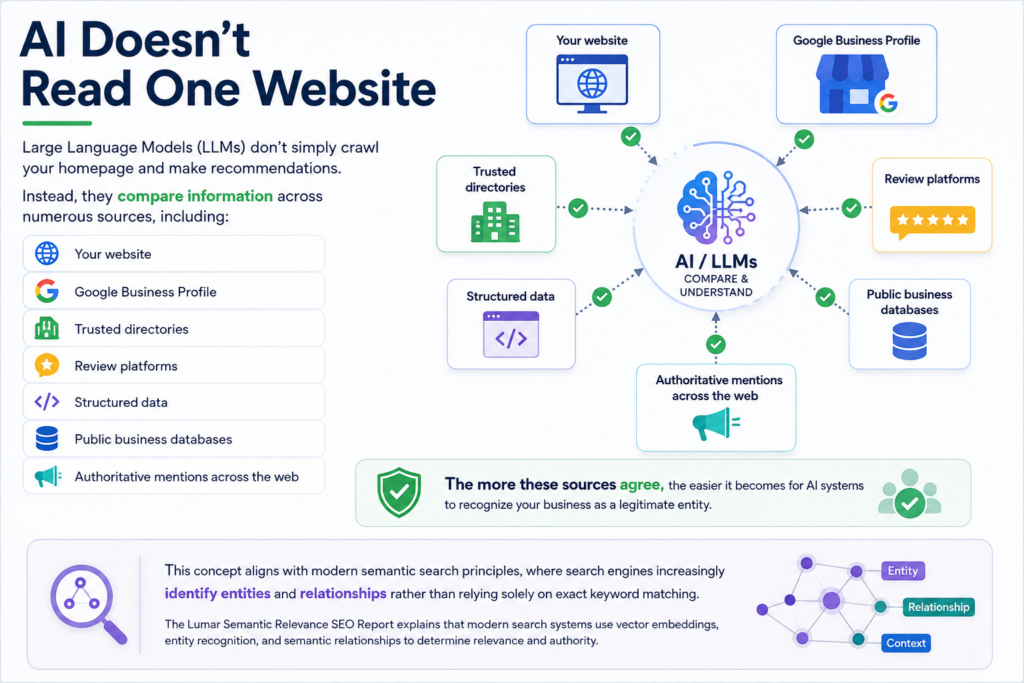
Large Language Models (LLMs) don’t simply crawl your homepage and make recommendations.
Instead, they compare information across numerous sources, including:
- Your website
- Google Business Profile
- Trusted directories
- Review platforms
- Structured data
- Public business databases
- Authoritative mentions across the web
The more these sources agree, the easier it becomes for AI systems to recognize your business as a legitimate entity.
This concept aligns with modern semantic search principles, where search engines increasingly identify entities and relationships rather than relying solely on exact keyword matching. The Lumar Semantic Relevance SEO Report explains that modern search systems use vector embeddings, entity recognition, and semantic relationships to determine relevance and authority.
AI Systems Reward Confidence
When AI systems encounter conflicting information, they become less certain.
For example:
- Different phone numbers
- Two business names
- Conflicting addresses
- Multiple websites
- Duplicate Google Business Profiles
These discrepancies introduce uncertainty into the entity resolution process.
Rather than recommending a business with inconsistent information, an AI system may instead choose a competitor whose digital footprint is more coherent.
That doesn’t necessarily mean the competitor has stronger SEO.
It simply means their business entity is easier to verify.
Entity SEO and Generative Engine Optimization (GEO)
Generative Engine Optimization (GEO) builds upon traditional SEO by helping AI systems understand and trust your business.
NAP consistency supports several GEO principles:
- Strong entity recognition
- Better Knowledge Graph alignment
- Consistent structured data
- Higher citation confidence
- Improved semantic relationships across the web
However, NAP consistency alone is not enough.
Businesses also need:
- Comprehensive service pages
- High-quality customer reviews
- Accurate Google Business Profile categories
- Local backlinks
- Helpful content
- Clear website structure
- Strong semantic relevance
As the Lumar report notes, modern search increasingly rewards semantically relevant, well-structured content that clearly communicates topics and entities rather than relying on keyword repetition alone.
ROI Spectrum’s Practical NAP Audit Framework
Many businesses assume they’ve “fixed” their citations after updating Google Business Profile.
Unfortunately, that’s only one piece of the puzzle.
At ROI Spectrum, local visibility audits begin with understanding the complete digital footprint of each business location.
Our process focuses on identifying inconsistencies before they affect rankings or AI visibility.
Step 1: Inventory Every Existing Citation
First, compile every location where your business information appears online.
This includes:
- Google Business Profile
- Website
- Major directories
- Industry listings
- Data aggregators
- Review sites
- Social profiles
- Local chambers of commerce
- Franchise or association websites
Many businesses discover listings they didn’t even know existed.
Step 2: Identify Conflicts
Next, compare every listing against your preferred business information.
Look for:
- Old phone numbers
- Previous office locations
- Tracking numbers
- Different business names
- Missing suite numbers
- Duplicate listings
- Misspelled addresses
- Different website URLs
Even small discrepancies can accumulate over time.
Step 3: Prioritize High-Authority Sources
Not every citation carries equal influence.
Updates should begin with:
- Google Business Profile
- Website
- Apple Business Connect
- Bing Places
- Primary data providers
- Major business directories
- Industry-specific platforms
Correcting high-authority sources often helps propagate accurate information throughout the local ecosystem.
Step 4: Implement Structured Data
Every location page should include accurate schema.org LocalBusiness markup.
Structured data reinforces:
- Business name
- Address
- Phone number
- Geographic coordinates
- Opening hours
- Website
- SameAs social profiles
This provides an additional layer of machine-readable consistency.
Step 5: Monitor Continuously
NAP consistency is not a one-time project.
Businesses regularly encounter changes caused by:
- Office relocations
- Rebranding
- New franchise locations
- Phone system upgrades
- Marketing tracking numbers
- Third-party directory updates
ROI Spectrum’s local SEO process includes automated monitoring across 50+ citation sources, helping identify new inconsistencies before they become larger visibility issues.
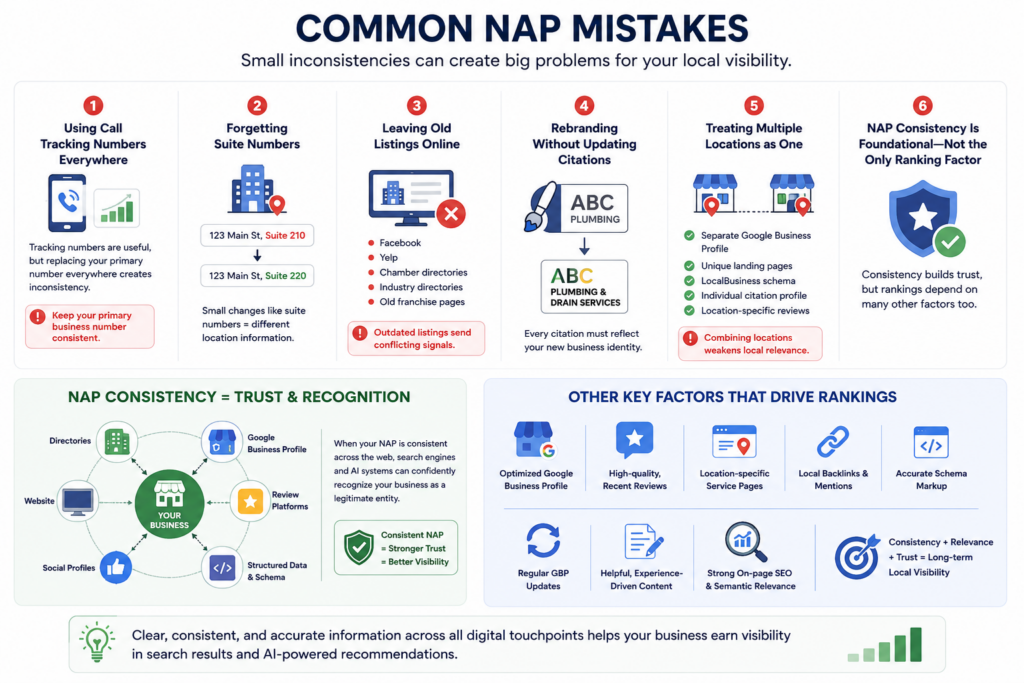
Common NAP Mistakes People does while doing NAP Citations
Across local service businesses, several patterns appear repeatedly.
Using Call Tracking Numbers Everywhere
Tracking numbers are valuable for measuring marketing performance.
However, replacing your primary business number across every citation can create unnecessary inconsistency.
Use dynamic call tracking where appropriate while maintaining a consistent primary business phone number in key citations.
Forgetting Suite Numbers
Moving from:
Suite 210
to
Suite 220
may seem minor.
For search engines, it represents different location information.
Leaving Old Listings Online
Businesses that relocate often update Google Business Profile but forget:
- Yelp
- Chamber directories
- Industry associations
- Old franchise pages
Those outdated listings continue sending conflicting signals.
Rebranding Without Updating Citations
Changing from:
ABC Plumbing
to
ABC Plumbing & Drain Services
requires far more than updating your logo.
Every citation should reflect the new business identity.
Treating Multiple Locations as One
Each physical office deserves its own:
- GBP
- Landing page
- LocalBusiness schema
- Citation profile
- Review strategy
Combining locations weakens local relevance for all of them.
NAP Consistency Is Foundational—Not the Only Ranking Factor
One of the biggest misconceptions in local SEO is that fixing NAP inconsistencies alone will dramatically improve rankings or guarantee inclusion in AI-generated recommendations.
The reality is more nuanced.
NAP consistency is a foundational trust signal. It helps search engines and AI systems confidently identify your business as a legitimate entity, but it works alongside many other ranking factors.
In 2026, successful local businesses typically combine consistent citations with:
- A fully optimized Google Business Profile
- High-quality, recent customer reviews
- Location-specific service pages
- Local backlinks and community mentions
- Strong on-page SEO and semantic relevance
- Accurate schema.org markup
- Regular GBP updates and engagement
- Helpful, experience-driven content that demonstrates expertise
As Google’s search systems continue to evolve toward semantic understanding, businesses that provide clear, structured, and trustworthy information across all digital touchpoints are better positioned to earn visibility. The Lumar Semantic Relevance SEO Report emphasizes that modern search engines prioritize semantic relevance, entity understanding, and well-structured content over simple keyword matching, reinforcing the importance of consistency alongside broader content quality.
How ROI Spectrum Helps Local Businesses Build Stronger Entity Signals
At ROI Spectrum, we view NAP consistency as the starting point—not the finish line.
Our local SEO process combines technical precision with a broader entity-first strategy designed to improve visibility across both traditional search and AI-powered discovery platforms.
A typical local visibility engagement includes:
- Comprehensive NAP audit across 50+ citation sources
- Citation cleanup and ongoing management
- Google Business Profile optimization
- LocalBusiness schema implementation and validation
- Multi-location SEO strategy
- Service-area and location page optimization
- Entity-focused content strategy
- Local link and authority building
- Ongoing monitoring for new inconsistencies
Over the years, we’ve worked with service-area businesses across industries such as plumbing, HVAC, dentistry, legal services, roofing, electrical contracting, and multi-location healthcare. While every business has unique challenges, one pattern appears consistently: businesses with accurate, well-managed local data are better positioned to build long-term visibility than those relying solely on one-time SEO tactics.
Just as importantly, we recognize that local search is evolving. Today’s optimization efforts must account not only for Google’s Local Pack but also for how AI assistants interpret and recommend businesses. That means combining technical SEO, entity optimization, and helpful content into a cohesive strategy rather than treating them as separate initiatives.
Frequently Asked Questions
Does a small formatting difference hurt local rankings?
Usually not.
Standard postal abbreviations such as Street vs. St., Avenue vs. Ave., or Suite vs. Ste. are generally understood by search engines as equivalent. The bigger concern is conflicting information, such as different phone numbers, outdated addresses, or inconsistent business names.
How often should I audit my NAP information?
For most businesses, a comprehensive audit every six to twelve months is a sensible baseline. You should also review your listings immediately after:
- Moving locations
- Changing phone numbers
- Rebranding
- Opening or closing offices
- Updating your website domain
- Launching a new Google Business Profile
Businesses with multiple locations or active marketing campaigns may benefit from more frequent monitoring.
Does NAP consistency still matter for AI search?
Yes.
Although AI search systems evaluate many signals—including reviews, website content, authority, and user intent—consistent business information helps them identify and verify your business entity across trusted sources.
As AI-generated local recommendations become more common, entity consistency is becoming increasingly important.
Can duplicate listings affect my visibility?
Yes.
Duplicate listings can split reviews, confuse customers, and introduce conflicting business information. They may also make it more difficult for search engines to determine which listing represents your official business.
Regular citation audits help identify and resolve duplicate profiles before they create larger problems.
Is Google Business Profile enough?
No.
Google Business Profile is one of the most important local SEO assets, but it is only one piece of your digital footprint.
Search engines and AI systems compare information across your website, business directories, social profiles, review platforms, structured data, and authoritative third-party sources. Consistency across all of these channels strengthens overall entity confidence.
Final Thoughts
Local search is no longer limited to a list of ten blue links or even Google’s Maps results.
Consumers are increasingly asking conversational questions through AI assistants, expecting a single trusted recommendation rather than dozens of search results.
In that environment, consistency matters.
Accurate business information helps Google, AI search platforms, and potential customers understand exactly who you are, where you operate, and why they can trust your business.
While NAP consistency won’t replace the need for quality content, customer reviews, or strong local authority, it provides the stable foundation those efforts rely on.
If your business hasn’t audited its citations recently—or you’re unsure whether outdated listings are affecting your visibility—now is the right time to address them.
Get a Free Local Visibility Audit from ROI Spectrum
Wondering whether inconsistent business information is limiting your visibility in Google Maps, AI Overviews, ChatGPT, or other AI-powered search experiences?
ROI Spectrum‘s Local SEO specialists can help you uncover hidden citation issues, evaluate your Google Business Profile, review your LocalBusiness schema, and identify opportunities to strengthen your local search presence.
Whether you operate a single location or manage dozens of branches, our comprehensive local visibility audit provides actionable insights to help you build a stronger, more trustworthy digital presence.
Ready to improve your local visibility?
👉 Request a free Local SEO audit today and discover how a consistent, entity-first approach can help your business earn greater visibility across both traditional search and the next generation of AI-powered discovery.