
If you’ve ever paid for a “one-time SEO audit,” you already know how this story ends. You get a 40-page PDF full of red, yellow, and green checkmarks. Someone walks you through it on a Zoom call. Three months later, your rankings haven’t moved, the PDF is buried in a Google Drive folder nobody opens, and Google has already rolled out two more core updates since the audit was written.
That’s not a failure of the audit. It’s a failure of the format. An audit is a snapshot; SEO is a moving target. Google runs multiple core algorithm updates every year, your competitors are actively building links and publishing content while you’re deciding whether to “revisit SEO next quarter,” and AI-driven search surfaces — Google’s AI Overviews, ChatGPT, Perplexity — are now rewriting how discovery happens altogether. A one-off engagement freezes your site’s optimization at a single point in time in a market that never stops moving.
That’s the entire premise behind a monthly SEO package: continuous, compounding optimization instead of a single burst of effort that decays the moment the invoice is paid.
Key Takeaways
Why monthly retainers beat one-off audits
Algorithm updates, competitor activity, and AI search shifts move constantly — a static audit decays the moment it’s delivered.
The 5 pillars any legitimate package should cover
- Technical & Site Health (Core Web Vitals, crawl budget, indexation)
- On-Page Optimization & Intent Mapping
- High-Intent Content Production (topic clusters, decay refreshes)
- Authority & Off-Page Acquisition (digital PR, citations)
- GEO/AEO (structuring content for AI Overviews, ChatGPT, Perplexity)
US pricing benchmarks
- Starter/Local: $500–$1,500/mo
- Growth/Regional: $1,500–$3,500/mo
- E-Commerce/Mid-Market: $3,500–$7,500/mo
- Enterprise: $7,500–$20,000+/mo
- Price swings mainly on competitive density, technical debt, catalog size, and speed-to-results expectations.
Proof of value
- Case Study (real, linked): the WholesaleBlanks engagement drove +46.3K organic sessions, +823.99K search impressions, +16.75K clicks, avg. position improved 6.2 places, and £5.06M in added attributed goal value.
Team required
A single freelancer can’t run all 5 pillars — proper execution needs a Senior Strategist, Technical SEO Analyst, Content Copywriter, Digital PR Lead, and Data Analyst.
Execution sequencing
Months 1–2 = foundation (audit, technical cleanup, architecture). Months 3–4 = content scaling + authority building. Months 5–6 = CRO and ROI scaling. Real ranking movement is a Month 3–6 story, not Month 1.
Red flags to walk away from
- “Guaranteed #1 ranking” promises
- $99–$300/mo packages (usually spam links or AI-spun content)
- 12-month lock-ins with no exit clause
Buyer framework
Match tier to actual complexity (not just budget), demand a 5-pillar deliverable breakdown, get a real team roster, and check contract exit terms before the case studies impress you.
A legitimate monthly retainer isn’t a vague bucket of “SEO work.” It should map cleanly to five operational pillars. If a proposal you’re reviewing can’t tell you which pillar a line item belongs to, that’s worth asking about.
Pillar 1: Technical & Site Health Maintenance
This is the plumbing. If it’s broken, nothing else in the package matters, because Google can’t crawl, render, or trust a site with unresolved technical debt.
- Core Web Vitals monitoring — Largest Contentful Paint (LCP), Cumulative Layout Shift (CLS), and Interaction to Next Paint (INP) tracked monthly, with fixes prioritized by revenue-impact pages first.
- XML sitemap management — dynamic sitemap updates as pages are added, removed, or restructured, submitted and validated in Google Search Console.
- 404 and redirect management — a live audit of broken links and legacy redirect chains, consolidated into clean 301 maps to preserve link equity.
- Crawl budget optimization — pruning low-value URLs (filtered/faceted parameters, thin tag pages) from the crawl path so Googlebot spends its time on pages that actually convert.
Pillar 2: On-Page Optimization & Search Intent Mapping
Industry rule of thumb: a page that ranks for the wrong intent will never convert, no matter how well it’s technically optimized.
- Title tag and meta description engineering — rewritten around commercial and informational intent, not just keyword density.
- Internal linking architecture — structured hub-and-spoke linking (guides → category pages → product/service pages) that distributes authority to revenue pages.
- Content decay refreshes — a recurring audit of pages that have lost rankings or traffic over the trailing 6–12 months, updated with fresher data, expanded coverage, and improved structure.
Pillar 3: High-Intent Content Production
- Topic cluster development — pillar pages supported by supporting articles, built around a full keyword universe rather than one-off blog posts.
- Monthly blog publication cadence — typically 2–8 articles per month depending on package tier, targeting a mix of top-, middle-, and bottom-of-funnel queries.
- Commercial page rewriting — service and category pages rewritten to balance conversion copywriting with the entity coverage search engines expect from an authoritative page.
Pillar 4: Authority & Off-Page Acquisition
- White-hat outreach and digital PR — earning links from journalists, industry publications, and partner sites through genuine newsworthy angles, not paid placements disguised as “guest posts.”
- Local citation building — for local and multi-location businesses, ensuring NAP (Name, Address, Phone) consistency across directories, which directly feeds Google’s local ranking algorithm.
- Link gap analysis — benchmarking your backlink profile against direct competitors to identify realistic, attainable link targets rather than vanity domains.
Pillar 5: Generative Engine Optimization (GEO / AEO)
This is the pillar that didn’t formally exist three years ago and is now non-negotiable.
- Structuring content for AI Overviews — writing in clearly extractable formats (direct-answer openers, structured lists, defined terms) that AI summarization engines can lift cleanly.
- Schema markup integration — FAQ, HowTo, Product, and Organization schema implemented site-wide to give search engines and AI crawlers unambiguous structured signals.
- Entity mapping for AI tools — ensuring your brand, services, and key personnel are consistently and correctly represented across the web so tools like Perplexity and ChatGPT can confidently cite you as a source rather than hedging with generic answers.
Search Engine Land and Gartner have both flagged this shift as one of the defining changes in search behavior heading into 2026: as AI-generated summaries increasingly sit above the traditional blue links, structured data and top-3 organic placement are reported to correlate with the large majority of citations pulled into AI-generated search summaries — meaning GEO/AEO work is no longer a nice-to-have add-on, it’s downstream of the same fundamentals (technical health, on-page clarity, authority) that have always driven rankings.
Transparent US Pricing & Tier Breakdown
Pricing varies by agency, market competitiveness, and scope — but industry benchmark surveys from sources like Ahrefs, AgencyAnalytics, and Clutch consistently show US monthly SEO retainers clustering between roughly $1,500 and $5,000 per month, with hourly consulting rates typically landing between $100–$250/hr for experienced practitioners. Packages outside that range usually sit at the extremes for a reason — either a very small local business with a narrow scope, or an enterprise account with multi-location or multi-market complexity.
| Tier | Monthly Range | Best For | Core Scope |
| Starter / Local SEO | $500 – $1,500/mo | Single-location small businesses, local service providers | Google Business Profile optimization, on-page basics, local citations, light content |
| Growth / Regional Business | $1,500 – $3,500/mo | Multi-location or regionally competitive businesses | Full technical + on-page program, monthly content, structured link outreach |
| E-Commerce / Mid-Market | $3,500 – $7,500/mo | Online retailers, catalog-driven businesses | Category/product optimization, schema at scale, digital PR, CRO integration |
| Enterprise | $7,500 – $20,000+/mo | National or multi-market brands, large catalogs | Dedicated team, custom reporting infrastructure, aggressive authority building, cross-market strategy |
What Actually Moves the Price
The tier table is a starting point, not a quote. Four variables move a proposal up or down within — or even outside — these ranges:
- Competitive density. Ranking a local plumber in a mid-sized market is a different job than ranking an e-commerce brand competing against Amazon-scale marketplaces for the same terms.
- Technical debt. A site migrated three times with no redirect hygiene, duplicate faceted navigation, and years of orphaned pages requires meaningfully more technical hours before content or links can even be effective.
- Catalog or service-line size. Optimizing 40 product categories is a different scope than optimizing 4,000 SKUs.
- Speed-to-results expectations. Compressing a normal 6–9 month growth curve into 3–4 months requires more parallel workstreams — and more monthly spend — to execute concurrently rather than sequentially.
Retainer vs. Project-Based Pricing
Most agencies structure monthly SEO as a retainer rather than a fixed-scope project, and for good reason: SEO isn’t a task you finish, it’s a process you maintain against a moving target (algorithm updates, competitor activity, and shifting search behavior). That said, some agencies offer a hybrid model — a larger fixed-fee technical overhaul in month one to clear a backlog of debt, followed by a lighter ongoing retainer for maintenance and growth. If your site has significant technical debt, ask whether the quoted monthly figure already accounts for that cleanup, or whether it’s a separate line item — this is one of the most common places a “$2,000/mo” quote quietly becomes a $2,000/mo-plus-a-$5,000-onboarding-fee reality.
Real-World Case Studies: Proof of Value
Case Study A: E-Commerce Growth — Real Client Results
Rather than presenting a hypothetical, here’s an actual documented outcome from a mid-market e-commerce account: a UK-based personalization/print-on-demand retailer (full case study published here) came in with classic mid-market e-commerce technical debt — duplicate content across category and product templates, weak entity signals, and thin internal linking between guides, categories, and product pages.
Execution applied: – Removed indexation blockers and refined robots directives, canonicalization, and XML sitemaps – Improved Core Web Vitals (LCP/CLS) and compressed media assets – Normalized duplicate content on category and product templates – Rewrote titles, H1s, and entity-rich intros with FAQ content across priority categories – Implemented Product, Breadcrumb, and FAQ schema – Tightened internal linking in a guides → categories → product-pages structure – Launched informational buying guides and pursued light digital PR for contextual backlinks
Documented results:
| Metric | Result |
| Organic sessions | 56.6K (+46.3K) |
| Search impressions | 1.1M (+823.99K) |
| Search clicks | 36.5K (+16.75K) |
| Average position | Improved by 6.2 places |
| Conversions | 6,200 (+6,226) |
| Attributed goal value | £5.1M (+£5.06M) |
| Organic share of total sessions | 54% |
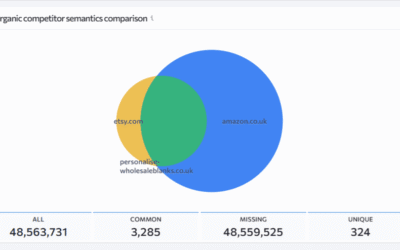
The competitive semantic gap analysis run alongside this campaign — benchmarking the client against Amazon.co.uk and Etsy.com — surfaced tens of millions of long-tail term opportunities the brand wasn’t yet targeting, underscoring a point that holds for almost every mid-market e-commerce account: the ceiling on organic growth is rarely the market, it’s the backlog of unaddressed technical and content gaps.
This kind of outcome is also consistent with broader industry ROI data. FirstPageSage and HubSpot research on channel-level returns has found that organic search commonly delivers a 5x–10x higher ROI than paid search when measured over a 12-month window — because organic gains compound and persist, while paid traffic stops the moment the budget does.
The Team & Experience Behind Your Campaign
A single freelancer, however talented, cannot competently run all five pillars above at once. Technical SEO, content strategy, digital PR, and data analysis are genuinely different skill sets — and when one person is stretched across all of them, something always gets deprioritized (usually the unglamorous technical maintenance work that doesn’t show up in a client-facing report).
A properly resourced monthly engagement should give you access to:
- Senior SEO Strategist — owns the overall roadmap, prioritization, and month-over-month strategic adjustments.
- Technical SEO Analyst — handles Core Web Vitals, crawl/indexation issues, schema implementation, and site architecture.
- Senior Content Copywriter — produces on-page rewrites, topic cluster content, and commercial page copy that’s built for both readers and search intent.
- Digital PR / Outreach Lead — runs the relationship-building and pitching required for genuine authority link acquisition.
- Data Analyst — maintains the reporting layer (GA4, Search Console, rank tracking) and translates raw numbers into decisions.
Tool stack to expect: Ahrefs or Semrush for keyword and competitive intelligence, Screaming Frog for technical crawls, Google Analytics 4 for behavioral data, Looker Studio for client-facing dashboards, and a schema builder/validator for structured data implementation. If a proposal doesn’t mention live reporting access — you should be able to see your own dashboard whenever you want, not wait for a monthly PDF — that’s worth pushing back on.
Month-by-Month Execution Roadmap
| Month | Focus |
| Month 1 | Onboarding, GA4/GSC audit, baseline metric mapping, and critical technical cleanup (indexation blockers, broken redirects, crawl errors) |
| Month 2 | Site architecture optimization, keyword mapping across the full site, and core on-page rewrites for priority pages |
| Month 3 | Content scaling begins, topic cluster rollout, and GEO/AI search schema setup |
| Month 4 | Authority link outreach ramps up, digital PR campaigns launch, citation synchronization completed |
| Months 5–6 | Conversion rate optimization (CRO) testing, content decay refreshes on early-stage pages, and ROI scaling based on what’s already proven to work |
This sequencing matters. Agencies that front-load content or link building before technical foundations are fixed are usually optimizing for a fast-looking activity report, not a durable ranking outcome — content built on a technically broken site has a ceiling that no amount of writing can push past.
Red Flags to Avoid When Shopping for Packages
If a proposal guarantees a #1 ranking in 30 days, walk away. No agency controls Google’s algorithm, and this claim directly violates the spirit of Google’s own webmaster guidelines around manipulative promises.
Watch for these specifically:
- “Guaranteed #1 ranking” promises. Nobody — not Google’s own employees — can guarantee a specific ranking position on a specific date. This is a sales tactic, not a technical possibility.
- $99–$300/mo “SEO packages.” At that price point, there is no realistic way to fund the labor five real pillars of work require. These packages are almost always powered by automated PBN (private blog network) link spam or AI-spun content with no editorial oversight — both of which carry real penalty risk and can actively damage a domain’s trust signals.
- Rigid 12-month lock-in contracts with no exit clause. A confident agency backs its own work with a reasonable notice period (commonly 30 days) rather than trapping clients in a contract regardless of performance. Long-term commitment can make sense once results are proving out — but it should never be the starting condition.
If a proposal on your desk right now hits any of these three, that’s a legitimate reason to ask harder questions before signing.
Why Hire ROI Spectrum as Your SEO Partner
Everything above is a framework for evaluating any agency. Here’s where we fit into it.
What we are. ROI Spectrum’s core promise is straightforward: high-quality, transparent SEO solutions that deliver measurable, sustainable growth. We built the platform primarily for small and mid-sized businesses — including solopreneurs — who want SEO tied directly to tangible business outcomes: online sales, bookings, appointments, and overall growth, not vanity ranking screenshots.
How we’re different. Most of the market splits into two camps: low-cost SEO that produces generic, one-size-fits-all work with unclear reporting, or high-cost enterprise retainers that price out smaller businesses entirely. We built our model around a different equation:
Customized strategy + transparent data + competitor intelligence + measurable business results.
We describe this internally as a results-driven investment — the point isn’t the lowest possible monthly fee, it’s accountability and long-term value. That’s an important distinction from the red flags above: a $99/mo package with no strategy behind it and an entry-level plan built on real customization are not the same category of offer. The difference is what’s actually included.
What the platform includes:
| Feature | What It Does |
| Customized SEO strategies | Tailored plans built around your specific business, not a generic template |
| Real-time analytics | Transparent, always-on performance data instead of a vague monthly recap |
| Google Analytics integration | Your performance data connects directly into GA4 |
| Google Search Console integration | Search-level performance data flows into the same platform |
| Competitor benchmarking | Ongoing monitoring against direct competitors to surface actionable opportunities |
| Results-focused reporting | Built around measurable outcomes and ROI, not activity counts |
| Transparent reporting | SEO activity and results presented in plain language, not agency jargon |
| Customer-centric updates | The platform evolves based on client feedback and industry/algorithm changes |
| Free SEO audits | Detailed audits available up front to demonstrate real opportunities before you commit |
| Account management | Enhanced, hands-on support for premium customers |
| Responsive support | Direct access to the team running your account, not a ticket queue |
Commercial model. Our current plan structure starts at $99/month for a customized SEO strategy, backed by a 1-month risk-free trial so you can evaluate the work before committing further. Every engagement starts with a free, detailed SEO audit — the same kind of audit-plus-roadmap approach this guide recommends — and annual subscriptions come with additional incentives. Premium customers get enhanced account management on top of the standard support tier.
Under the hood, this is powered by proprietary infrastructure most agencies don’t have: a multi-axis recommendation engine that maps your specific inputs against dozens of viable service combinations to avoid recommending a package that doesn’t fit your business, live dashboard reporting instead of static monthly PDFs, and structured entity/knowledge-layer mapping built for each client — which feeds directly into the GEO/AEO work described in Pillar 5.
Frequently Asked Questions
How long does it take to see results from a monthly SEO package? Meaningful ranking and traffic movement typically begins in Month 3–4, once technical fixes have been recrawled, and initial content/authority work has had time to be indexed and evaluated by Google. Month 1–2 is foundation-building — real, necessary work, but not yet reflected in rankings.
Can I cancel a monthly SEO package if it’s not working? You should be able to. Reasonable agreements include a 30-day notice period rather than a rigid annual lock-in. If a contract has no exit clause tied to performance or a reasonable notice window, treat that as a negotiating point before signing, not after.
Is a cheaper SEO package ever a reasonable choice for a small business? Yes — a genuinely scoped Starter/Local package in the $500–$1,500/mo range can be appropriate for a single-location business with a narrow service area and low competition. The red flag isn’t a lower price on its own; it’s a low price paired with promises (guaranteed rankings, unrealistic timelines) that the budget can’t actually support.
What’s the difference between SEO and GEO/AEO? Traditional SEO optimizes for ranking in the traditional blue-link results. GEO (Generative Engine Optimization) and AEO (Answer Engine Optimization) extend that same foundational work — clean technical structure, clear entity signals, well-organized content — toward being cited directly inside AI-generated answers on platforms like Google AI Overviews, ChatGPT, and Perplexity. The two aren’t competing disciplines; GEO/AEO builds on top of solid traditional SEO rather than replacing it.
Do I need a separate budget for content and link building, or is that included? In a properly scoped monthly package, content production and outreach/link building should be included in the retainer, not billed as constant add-ons. It’s reasonable for an agency to scope a heavier one-time content push (e.g., a full site copy rewrite) separately — but recurring blog content and standard outreach should be part of the core monthly deliverables at every tier above Starter.
Conclusion & Buyer Decision Framework
Choosing a monthly SEO package comes down to matching scope to reality:
- Match the tier to your actual complexity — not just your budget ceiling. An enterprise-scoped catalog on a Starter-tier retainer will never see the technical and content hours it needs.
- Demand a five-pillar breakdown, not a vague monthly activity list. If a proposal can’t tell you which deliverables map to technical, on-page, content, authority, and GEO/AEO work, ask for that clarity before signing.
- Ask for a real team roster, not just an account manager’s name.
- Read the contract terms before the case studies. A strong 6-month case study means very little if you’re locked into 12 months with no exit path.
- Treat the first 90 days as foundation-building, not results-measuring. Legitimate technical and architectural fixes take time to be recrawled, reindexed, and reflected in rankings — real movement is typically a Month 3–6 story, not a Month 1 story.
If you’re evaluating your current organic performance against what’s actually possible for your market and budget, the fastest way to find out is a direct look at your site’s technical foundation and competitive gap — not another generic audit PDF.
Ready to see where your site actually stands? Book a custom strategy session or request a free technical site audit, and get a real, prioritized roadmap instead of a checklist that sits unread in a shared drive.