
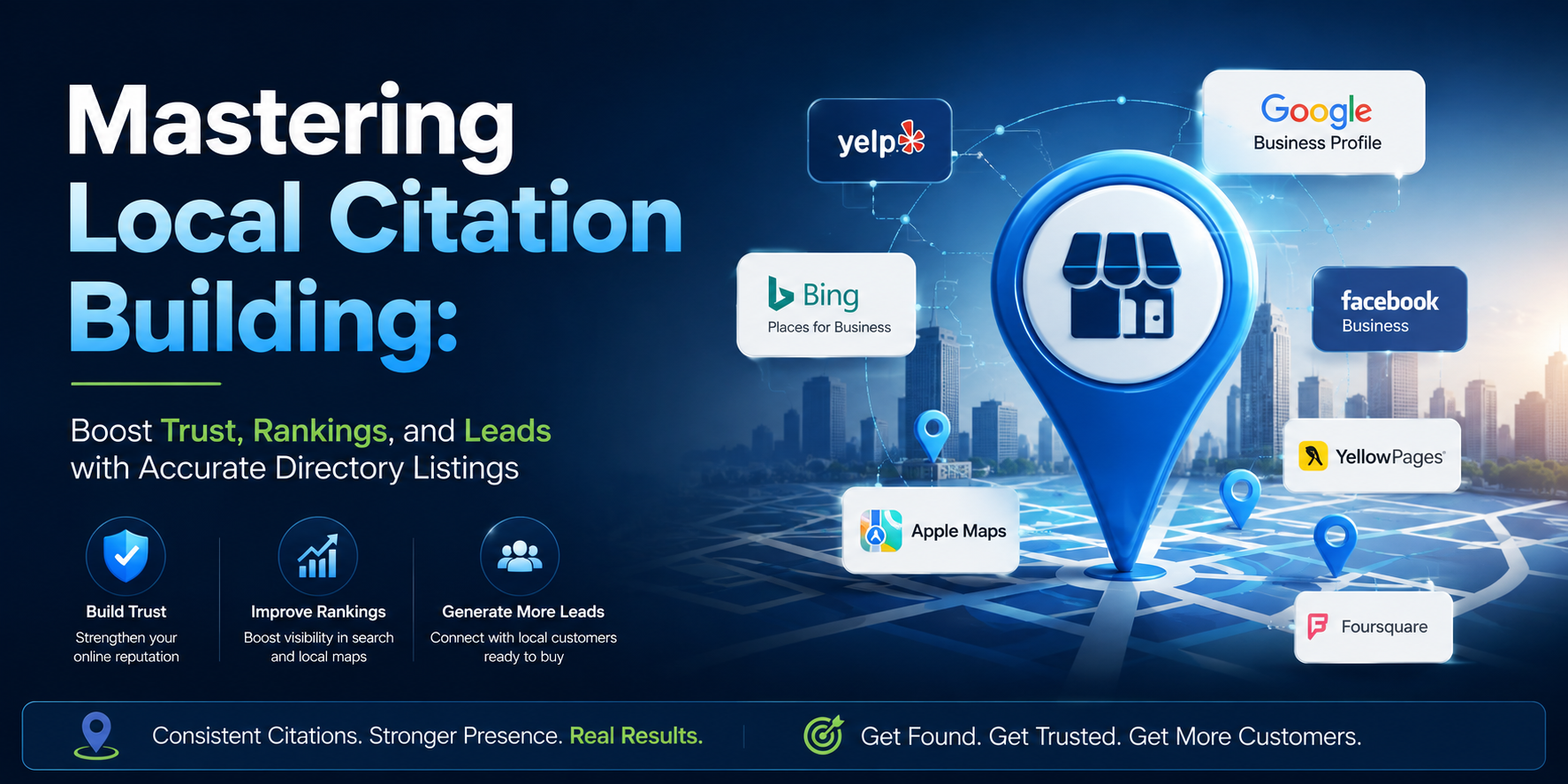
Introduction – What Are Local Citations and Why They Matter
Local citations are online mentions of your business information, usually your name, address, and phone number. They appear on directories, maps apps, review platforms, local chamber sites, industry portals, data aggregators, social profiles, and sometimes news or community websites.
For a local business, citations are part of the trust layer of the web. Search engines use them to confirm that your business exists, serves a real location or service area, and can be contacted by customers. People use them for the same reason, often without thinking about it. If someone finds your business on Google, checks your reviews on Yelp, taps directions in Apple Maps, and sees a different phone number on another directory, trust drops fast.
That is why local citation building is not just a box to tick for SEO. It supports three business outcomes at once:
- Better local search rankings, especially when directory data reinforces your Google Business Profile
- Stronger customer trust through consistent, complete, and current business details
- More leads from high-intent users searching in maps, directories, and local results
Recent local SEO guidance keeps coming back to the same point: accuracy matters. E10K’s 2025 local SEO best practices highlight that incorrect or outdated details, such as business hours, addresses, or services, can hurt rankings and customer trust. Semrush also emphasizes that NAP information should stay consistent across citation sources, and its Listing Management workflow is built around finding listing problems and correcting them at scale.
At ROI Spectrum, we often see citation work make the biggest difference for businesses that have moved locations, changed phone systems, expanded service areas, or acquired another company. Those moments create messy data trails. A citation audit often uncovers old suite numbers, tracking phone numbers, outdated hours, duplicate Google Business Profile listings, and category mismatches that have been quietly confusing search engines and customers for years.
Citations are not a replacement for your Google Business Profile
Your Google Business Profile is still the anchor of local visibility for most businesses. It can appear in Google Maps, the local pack, and standard search results. A complete profile with accurate categories, services, photos, hours, reviews, and posts can be one of the strongest drivers of local traffic.
Citations support that anchor. Think of your Google Business Profile as the source customers interact with most often, while citations are the network of corroborating signals around it. When those signals match, your local presence is easier to trust. When they conflict, performance can suffer.
The Anatomy of a Strong Local Citation – NAP, Categories, and Reviews
A strong citation is not just a directory listing that exists. It is a listing that is accurate, complete, and aligned with how customers search. The best citations combine clean business data with enough context to help a person choose you over a competitor.
NAP consistency is the foundation
NAP stands for name, address, and phone number. NAP consistency means those details appear the same way across important directories and platforms.
That does not mean every comma or abbreviation must be identical in a way no human would care about. Search engines are usually smart enough to understand that St. and Street refer to the same thing. But meaningful differences can cause problems, especially when they involve:
- Different business names, such as using a legal entity name on one platform and a customer-facing brand name on another
- Old addresses, old suite numbers, or virtual office addresses
- Multiple phone numbers, especially call tracking numbers used without proper setup
- Inconsistent website URLs, such as linking some listings to the homepage and others to an outdated location page
- Conflicting hours, holiday hours, or appointment-only status
If your business has multiple locations, each location needs its own clean NAP profile. Do not use one central phone number for every listing unless that is truly how customers should contact each location. Local landing pages should also match the location details used in citations.
Categories shape relevance
Categories tell directories and search engines what your business is. They influence when your listing appears and how relevant it looks for a search query.
Choose the most specific primary category available. A pediatric dentist should not settle for dentist if the platform offers pediatric dentist. A personal injury law firm should not use general legal services if personal injury attorney is available. Secondary categories can help cover additional services, but stuffing every available category can make a listing look unfocused.
Directories vary in how they handle categories. Google Business Profile categories differ from Yelp categories, Bing Places categories, and Apple Business Connect categories. The goal is not to force perfect category parity. The goal is to map each platform’s options to the clearest description of what you actually do.
Reviews turn citations into reputation assets
A directory listing with accurate NAP helps search engines. A listing with strong reviews helps customers decide.
Reviews influence online reputation, click behavior, and lead conversion. SurferSEO’s reputation management guidance notes that platforms like Google Maps, Apple Maps, Bing Places, Yelp, and general directories shape how brick-and-mortar businesses are perceived. Another local reputation guide points to GBP clicks, calls, direction requests, lead generation, and conversion rates as practical ways to connect reputation work with real business outcomes.
A good citation strategy should include review management basics:
- Ask satisfied customers for reviews on the platforms that matter most in your market
- Respond to positive and negative reviews with specific, professional language
- Monitor review velocity, rating trends, and recurring customer themes
- Never offer incentives that violate platform policies
- Do not copy and paste the same response to every review
Reviews also help citations stand out. If two businesses have similar listings, the one with a higher rating, fresher reviews, better photos, and clearer service details is more likely to earn the call.
Top U.S., Canada, and U.K. Directories to Target (Yelp, Bing Places, Apple Business Connect, Yell, Yellow Pages Canada)
Not every citation source deserves equal attention. A listing on a trusted platform with real users and strong search visibility is more valuable than a listing on a thin directory nobody visits. Start with the platforms customers and search engines already trust, then expand into niche and local opportunities.
Core platforms worth prioritizing
The right mix depends on your country, industry, and service model, but these directories are common starting points for small businesses in the U.S., Canada, and the U.K.
| Directory or platform | Best fit | Why it matters | Practical tip |
|---|---|---|---|
| Google Business Profile | U.S., Canada, U.K., most local businesses | Primary visibility in Google Search and Maps | Keep categories, services, hours, photos, and reviews actively updated |
| Yelp | U.S. and some international markets | Strong review platform, often ranks well for local searches | Complete service details and monitor reviews closely |
| Bing Places | U.S., Canada, U.K. | Supports visibility in Bing search and maps experiences | Import from Google Business Profile when appropriate, then verify details manually |
| Apple Business Connect | U.S., Canada, U.K. | Feeds Apple Maps and other Apple experiences | Add logos, photos, business hours, and action links where available |
| Yell | U.K. | Major U.K. business directory with local search relevance | Use accurate categories and a keyword-conscious description |
| Yellow Pages Canada | Canada | Established Canadian directory for local discovery | Confirm bilingual or regional details when relevant |
| Facebook business pages | Broad | Often appears in branded searches and supports customer messaging | Keep hours and contact details aligned with your main listings |
| Better Business Bureau | U.S. and Canada | Trust signal for many service businesses | Make sure accreditation status and business details are accurate |
| Industry directories | Varies | High relevance for legal, medical, home services, hospitality, and B2B | Prioritize directories customers actually use |
| Local chambers and associations | Local markets | Strong geographic relevance | Join legitimate organizations, not link farms |
Go beyond the obvious directories
Backlinko’s local SEO guidance for 2026 makes a useful point: after the usual suspects like Yelp and Foursquare, it is time to go local. Local citations can support map pack rankings, and outreach to nearby organizations often converts well because the relationship is geographically relevant.
This is where many small businesses can gain an edge. Competitors may all have the same automated directory listings, but fewer have local community citations from:
- Chamber of commerce member directories
- Downtown business associations
- Local sponsorship pages
- Neighborhood guides
- Local newspaper business directories
- Event partner pages
- Supplier, distributor, or manufacturer dealer locators
- Professional association directories
- Tourism boards for hotels, restaurants, venues, and attractions
These citations may not all look like traditional directories, but they still reinforce who you are, where you operate, and what you do. They can also send qualified referral traffic.
Match directory priorities to customer behavior
A restaurant, roofer, dentist, med spa, accountant, and wedding venue should not have identical citation plans. For example, Yelp may be essential for restaurants and home services in some U.S. cities, while industry-specific directories may matter more for attorneys or healthcare providers. Apple Business Connect is increasingly important for businesses that rely on map navigation, walk-ins, or mobile discovery. Bing Places may not drive the same volume as Google, but ignoring it leaves visibility on the table, especially for audiences using Microsoft products.
At ROI Spectrum, we usually prioritize directories by asking three questions: does it rank for relevant local searches, does it feed data to platforms customers use, and can it generate actual leads? If the answer is no to all three, it probably belongs lower on the list.
Step‑by‑Step Guide to Building and Managing Citations
Citation building works best when it follows a controlled process. Randomly submitting listings can create duplicates, spread bad data, and make cleanup harder later.
Step 1: Establish your source of truth
Before touching directories, create a master business profile. This document should be the single reference for every listing.
Include:
- Official business name as customers know it.
- Full address, including suite number if applicable
- Local phone number
- Website URL and preferred location landing page
- Primary and secondary categories
- Business description in short and long versions
- Hours, holiday hours, and appointment requirements
- Services, products, brands carried, or specialties
- Service areas, if you travel to customers
- Photos, logo, and brand assets
- Social profile URLs
- Review response guidelines
For service-area businesses, be careful with address visibility. Some platforms allow you to hide your street address if customers do not visit your location. Follow each platform’s rules instead of forcing a storefront format that does not match your business.
Step 2: Run a citation audit
A citation audit identifies where your business is listed, which listings are accurate, which are incomplete, and which are harmful or duplicative. This is where you find the data problems that have accumulated over time.
You can audit manually by searching for variations of your business name, address, and phone number, or you can use tools such as Semrush Listing Management, BrightLocal, Moz Local, Yext, Whitespark, or similar platforms. Semrush’s local SEO guidance specifically calls out listing management tools for building citations and ensuring consistent NAP information across sources.
Search for:
- Current business name plus city
- Old business names
- Current phone number
- Old phone numbers
- Current address
- Old addresses
- Owner names, if they appear in listings
- Common misspellings
Document each listing URL, status, login access, accuracy, and action needed. Do not skip this step. Building new citations on top of dirty data is like painting over water damage.
Step 3: Claim and optimize your priority listings
Start with Google Business Profile, Bing Places, Apple Business Connect, Yelp, and the highest-value directories for your country and industry. Claiming usually requires phone, email, postcard, video, or document verification.
Once verified, complete each profile as fully as the platform allows:
- Use the correct primary category
- Add a concise, customer-focused business description
- Upload high-quality exterior, interior, staff, product, and service photos
- Add hours, special hours, and holiday closures
- List services and products where supported
- Link to the most relevant page on your website
- Enable messaging, booking, menus, or appointment links if you can manage them reliably
- Add accessibility, payment, parking, or amenity details where relevant
Completeness matters because directory users are often close to taking action. They want to call, book, get directions, compare reviews, or confirm that you serve their area.
Step 4: Fix incorrect citations and suppress duplicates
After claiming priority listings, correct inaccurate listings found in the audit. For duplicates, do not simply create another new listing. Most major platforms have a process to report, merge, or suppress duplicates.
Duplicate listings are especially common when:
- A business moved locations
- A practitioner left a clinic or firm
- A franchise location changed ownership
- A call tracking number was used in old campaigns
- Data aggregators picked up inconsistent records
- Someone created a listing years ago and lost access
Keep notes on every request. Some platforms take days; others take weeks. Data cleanup is not instant, and old information can resurface if it remains in upstream sources.
Step 5: Build niche and local citations
Once the major platforms are accurate, expand. Look at competitors ranking well in your area and identify citation sources they have that you do not. Backlink gap tools can help, but manual search still works.
Try searches like:
- city + business directory
- city + chamber of commerce + your industry
- industry + directory + state or province
- best your service in city
- local association + your profession
- supplier brand + dealer locator
Prioritize legitimate sites with real audiences, editorial standards, and local or industry relevance. Avoid directories that exist only to sell links or publish scraped business data.
Step 6: Create a maintenance rhythm
Citations are not set-and-forget assets. Businesses change. Platforms change. Data gets overwritten.
Review your core listings at least quarterly and any time you change:
- Address
- Phone number
- Website domain or landing pages
- Hours
- Services
- Business name
- Ownership
- Service area
- Categories
For businesses with seasonal hours, frequent promotions, or multiple locations, monthly checks are safer. A small inconsistency can become a bigger issue once it spreads through the local data ecosystem.
Common Pitfalls and How to Avoid Them – Duplicate Listings, NAP Inconsistencies, and More
Citation mistakes usually happen for understandable reasons. Someone moved offices, launched a new website, hired a marketing vendor, or created a profile without realizing one already existed. The problem is that local data has a long memory.
Duplicate listings
Duplicate listings split signals and confuse customers. A user might find an old listing with no reviews, wrong hours, or a disconnected phone number. Search engines may also struggle to determine which record is authoritative.
How to avoid it:
- Search before creating any new listing
- Claim existing listings instead of starting over
- Merge duplicates when the platform allows it
- Keep former practitioner or staff listings updated if they are relevant
- Track login credentials in a secure shared system
NAP inconsistencies
Inconsistent NAP is one of the most common local SEO issues. It can be caused by old tracking numbers, rebrands, abbreviations, suite changes, or third-party data providers.
How to avoid it:
- Use a master NAP document
- Update primary data sources before smaller directories
- Use call tracking carefully, preferably with dynamic number insertion on your website and platform-compliant tracking on listings
- Keep location pages consistent with directory data
- Audit after any move, rebrand, or acquisition
Wrong categories
A business can be perfectly listed but poorly categorized. That weakens relevance. If a directory thinks a remodeling company is a general contractor, but its best leads come from kitchen remodeling, the category choice may be too broad.
How to avoid it:
- Choose the most specific accurate primary category
- Review competitor categories on major platforms
- Match categories to actual revenue-driving services
- Avoid irrelevant secondary categories
Thin or neglected profiles
A listing with only NAP is better than nothing, but it may not convert. Missing photos, sparse descriptions, unanswered reviews, and outdated hours signal neglect.
How to avoid it:
- Add real photos, not only stock images
- Refresh photos periodically
- Respond to reviews
- Use service descriptions that reflect customer language
- Keep holiday hours current
Overusing low-quality directories
More citations are not automatically better. Hundreds of low-value listings can be difficult to manage and may not improve performance. Quality, relevance, and consistency matter more.
How to avoid it:
- Prioritize authoritative national, regional, industry, and local sources
- Skip directories with spammy outbound links or no visible standards
- Avoid paying for listings unless the platform has real audience value
- Review whether a citation can drive referral traffic, trust, or local relevance
Ignoring reputation signals
Citation building and online reputation overlap. If your business has accurate listings but poor ratings or unanswered complaints, leads may still choose someone else.
How to avoid it:
- Ask for reviews as part of normal customer follow-up
- Train staff to recognize review-worthy moments
- Respond to complaints without defensiveness
- Track themes in reviews and share them with operations teams
This is where citation management becomes more than SEO. It becomes part of customer experience.
Measuring Success – Metrics, Tools, and Reporting for Citation Performance
Citation work can feel invisible if you only look for immediate ranking jumps. Some effects are direct, such as referral clicks from Yelp. Others are indirect, such as stronger trust signals that support local rankings and conversions over time.
Metrics to track
Use a mix of visibility, accuracy, engagement, and lead metrics.
- Listing accuracy score: Percentage of priority listings with correct NAP, hours, URL, and categories
- Duplicate count: Number of duplicate or conflicting listings found and resolved
- Local search rankings: Movement in map pack and organic local results for target keywords
- Google Business Profile actions: Calls, website clicks, direction requests, bookings, and messages
- Directory referral traffic: Sessions and conversions from Yelp, Bing, Apple Maps-related traffic where trackable, Yell, Yellow Pages Canada, and niche directories
- Review metrics: Average rating, review count, review velocity, response rate, and sentiment themes
- Lead volume: Calls, form submissions, appointment requests, and walk-in indicators
- Conversion rate: Percentage of local traffic or listing visitors that become leads
Do not judge success from one metric alone. A business can improve citation accuracy before rankings move. Reviews may lift conversions even if traffic stays flat. A new Apple Business Connect profile may help mobile users navigate but be harder to attribute cleanly in analytics.
Tools that help manage and report
You can manage citations manually if you have one location and a limited directory footprint. As locations, platforms, or markets grow, tools become useful.
Common options include:
- Semrush Listing Management for citation distribution, consistency checks, and local listing visibility
- BrightLocal for citation audits, rank tracking, and local SEO reporting
- Moz Local for listing distribution and ongoing data management
- Yext for larger-scale listing control across a broad network
- Whitespark for citation building, audits, and local citation discovery
- Google Business Profile Performance for calls, clicks, bookings, messages, and direction requests
- Google Search Console for local landing page impressions and clicks
- Google Analytics 4 for referral traffic and conversions
- Call tracking platforms for lead attribution, when configured carefully
The best tool depends on your budget, number of locations, and need for manual control. Automated distribution is efficient, but manual claiming is still valuable for high-priority profiles that need custom optimization.
Reporting that clients and owners actually understand
A useful citation report should not be a spreadsheet dump. Tie the work to outcomes.
A monthly or quarterly report might include:
- Listings created, claimed, corrected, or merged
- Accuracy score before and after cleanup
- Remaining duplicate issues and platform response status
- Ranking changes for priority local keywords
- GBP calls, clicks, and direction requests
- Review growth and response rate
- Leads attributed to directory referral traffic
- Next actions for high-impact listings
At ROI Spectrum, we like to separate completed cleanup from ongoing maintenance. That makes progress easier to see. A business owner may not care that 47 listings were updated, but they will care that the old phone number stopped appearing on page one, calls from Google Business Profile increased, and Yelp now shows the correct service area.
Set realistic expectations
Citation cleanup can produce quick wins when glaring errors are fixed, but local SEO is competitive. Rankings also depend on proximity, relevance, prominence, website quality, reviews, links, behavioral signals, and competitor activity. Citations are one piece of the local search system, not a magic switch.
That said, they are one of the most controllable pieces. You cannot change where a searcher stands when they
look for a nearby service. You can control whether your business information is accurate, complete, and trusted across the web.
Conclusion and Next Steps – How to Scale Your Local Citation Strategy
Local citation building is about making your business easier to verify, easier to trust, and easier to contact. Accurate directory listings support local search rankings, strengthen online reputation, and help turn high-intent searches into calls, bookings, visits, and form submissions.
Start with the basics: clean up your Google Business Profile, Yelp, Bing Places, Apple Business Connect, and the major directories in your market, such as Yell in the U.K. and Yellow Pages Canada in Canada. Then expand into industry-specific and local citation sources that competitors may have overlooked.
A practical 30-day action plan
If you want to move from reading to execution, use this plan:
- Days 1 to 3: Create your master business profile with approved NAP, categories, descriptions, hours, services, photos, and URLs
- Days 4 to 7: Run a citation audit and document incorrect, missing, incomplete, and duplicate listings
- Days 8 to 14: Claim and optimize your highest-priority profiles, starting with Google Business Profile, Bing Places, Apple Business Connect, and Yelp
- Days 15 to 21: Correct NAP inconsistencies, request duplicate merges, and update outdated hours or URLs
- Days 22 to 26: Build niche and local citations through chambers, associations, local guides, and industry directories
- Days 27 to 30: Set up reporting for rankings, GBP actions, referral traffic, reviews, and leads
Once the foundation is clean, scaling becomes easier. Multi-location businesses should create a repeatable playbook for new locations, including naming conventions, landing page rules, photo standards, category mapping, and review workflows. Service-area businesses should define their real coverage area clearly and avoid creating listings for locations that do not exist.
The long-term goal is not to chase every directory on the internet. It is to build a citation ecosystem that is accurate, relevant, and durable. Keep your information clean, earn reviews consistently, monitor the platforms customers actually use, and revisit your citation audit whenever the business changes.
If you need a structured cleanup or a scalable local listing process, ROI Spectrum can help map the priorities, fix the data issues, and connect citation management to measurable local SEO performance.