

SEO & AI Visibility for Cleaning Companies in Canada: How to Rank in Google Maps, AI Overviews & ChatGPT in 2026
Introduction: Local Search Has Changed, But Cleaning Companies Still Win by Being Found First
If you own a cleaning or janitorial company in Canada, you’re competing in one of the country’s most competitive local service markets. Whether you specialize in commercial janitorial contracts, residential house cleaning, post-construction cleaning, carpet cleaning, or eco-friendly cleaning services, your next customer is almost certainly searching online before picking up the phone.
But the way Canadians discover local businesses has changed dramatically.
Today, potential customers don’t just search Google anymore. They ask questions inside Google AI Overviews, Google AI Mode, ChatGPT, Gemini, and Perplexity. Instead of scrolling through ten blue links, users increasingly receive AI-generated recommendations, summarized answers, and curated local business suggestions.
For Canadian cleaning businesses, this creates both a challenge and an opportunity.
Businesses that invest only in traditional SEO risk losing visibility to competitors that optimize for both search engines and AI-powered answer engines. At the same time, companies that abandon proven local SEO fundamentals in pursuit of “AI hacks” often overlook what still drives the majority of qualified leads: Google Business Profile, Google Maps, local reviews, and location-specific authority.
The reality in 2026 is simple:
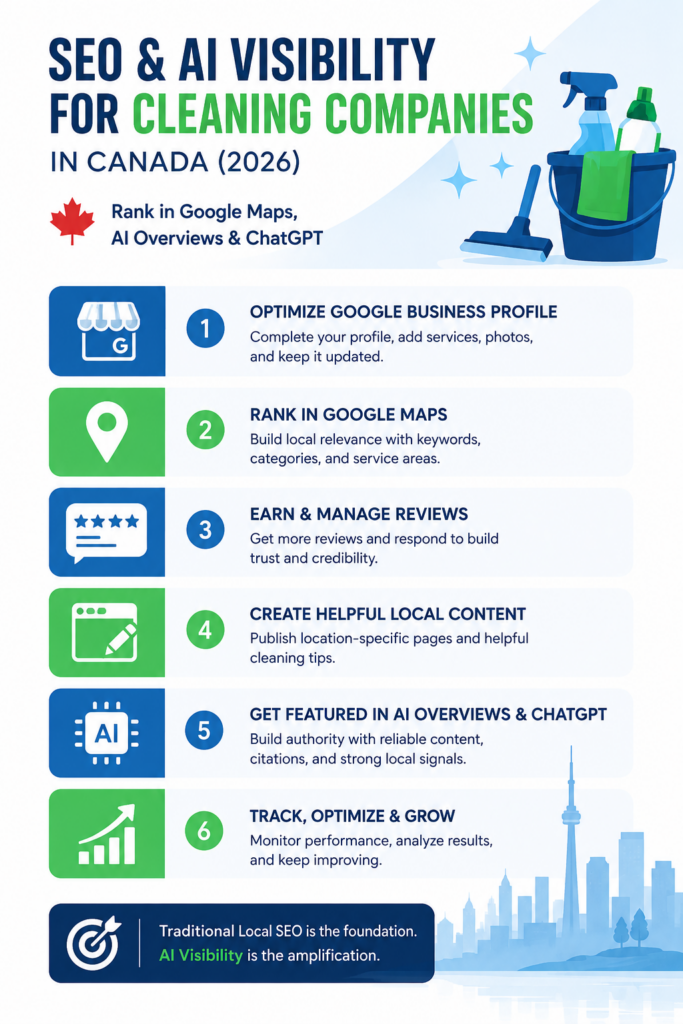
Traditional Local SEO remains the foundation. AI visibility is the amplification layer.
The businesses earning the most phone calls today aren’t choosing between Google Maps and AI—they’re building visibility systems that appear everywhere customers look.
At ROI Spectrum, we’ve seen the same pattern across local service industries:
- Businesses ranking in Google’s Local Pack receive significantly more calls than those relying solely on organic rankings.
- Companies with structured local content, consistent business information, and strong review profiles are increasingly referenced across AI-powered search experiences.
- Businesses that publish genuinely helpful, experience-driven content are far more likely to build long-term authority than those chasing algorithm shortcuts.
The goal isn’t simply higher rankings.
The goal is more booked jobs, recurring commercial contracts, and qualified leads.
This guide explains exactly how Canadian cleaning companies can achieve both.
The Canadian Cleaning Industry in 2026: Why Local Search Matters More Than Ever
Cleaning services have become one of Canada’s fastest-growing local service sectors.
Demand continues to increase across multiple verticals:
- Commercial office cleaning
- Medical facility sanitation
- Industrial cleaning
- Condominium maintenance
- Residential recurring cleaning
- Move-in / move-out cleaning
- Green cleaning services
- Post-construction cleaning
Several long-term trends continue driving this growth:
- Hybrid workplaces requiring flexible cleaning schedules
- Increased health and sanitation awareness
- Labour shortages encouraging outsourced facility management
- Growing demand for environmentally responsible cleaning products
- Expansion of commercial real estate in major metropolitan regions
Industry reports estimate that Canada’s janitorial and commercial cleaning industry generates billions of dollars in annual revenue while supporting tens of thousands of businesses nationwide. (Final revenue figures should be verified before publication.)
For local companies, however, market growth alone doesn’t guarantee more customers.
Visibility determines who wins.
When someone searches:
- commercial cleaning Toronto
- office cleaning Mississauga
- janitorial company Vancouver
- house cleaners Calgary
- green cleaning services near me
Google rarely shows hundreds of businesses.
Instead, users typically encounter:
- Google AI Overview (where available)
- Sponsored Ads
- Google Map Pack
- Organic results
- Additional AI-assisted recommendations
The businesses occupying these positions capture a disproportionate share of calls and quote requests.
Why Traditional Local SEO Still Drives Most Cleaning Leads
With so much attention on AI, it’s easy to assume traditional SEO is becoming obsolete.
It isn’t.
In fact, AI systems largely rely on the same trust signals Google has refined over the past decade.
That means cleaning companies still need to master the fundamentals.
1. Google Business Profile Remains Your Most Valuable Asset
For most cleaning companies, Google Business Profile (GBP) generates more qualified local leads than any other digital asset.
When someone searches:
commercial cleaners near me
Google often displays a Map Pack before traditional organic listings.
Businesses appearing here benefit from:
- One-click phone calls
- Direction requests
- Website visits
- Review visibility
- Service highlights
- Photos
- Business hours
- FAQs
Many cleaning companies spend thousands on advertising while neglecting their GBP profile.
That’s a costly mistake.
A high-performing profile should include:
- Primary and secondary service categories
- Detailed service descriptions
- High-quality before-and-after images
- Team photos
- Service-area coverage
- Regular updates
- Frequently Asked Questions
- Booking links
- Products and services
- Consistent NAP information
Google increasingly rewards profiles that demonstrate active business management rather than passive ownership.
2. Reviews Are More Than Social Proof
Reviews have evolved into one of the strongest trust signals available.
They’re no longer just for customers.
They’re also consumed by AI systems.
Strong review profiles help communicate:
- Service quality
- Reliability
- Geographic relevance
- Industry specialization
- Customer satisfaction
- Experience
For cleaning businesses, detailed reviews often mention valuable entities such as:
- Office cleaning
- Restaurant cleaning
- Warehouse cleaning
- Carpet cleaning
- Green cleaning
- Apartment turnover cleaning
- School cleaning
- Medical office cleaning
These natural mentions reinforce topical authority without artificial keyword stuffing.
Review quality matters as much as quantity.
A review saying:
“Great service.”
is far less valuable than:
“MCA Group has cleaned our 18,000-square-foot medical clinic in Mississauga every week for two years. Reliable staff, excellent communication, and outstanding sanitation standards.”
The second review helps both Google and AI systems understand:
- Industry expertise
- Location
- Business size
- Service specialization
- Long-term client satisfaction
Review recency also matters.
Consistently earning new reviews signals that your business remains active and trusted.
3. Local Landing Pages Build Geographic Authority
Many Canadian cleaning companies create a single “Service Areas” page listing dozens of cities.
Unfortunately, that approach rarely performs well.
Instead, each major service area deserves its own comprehensive page.
Examples include:
- Commercial Cleaning Toronto
- Office Cleaning Mississauga
- Janitorial Services Vaughan
- Industrial Cleaning Calgary
- House Cleaning Vancouver
- Condo Cleaning Richmond Hill
Each location page should contain:
Local customer problems
Discuss real cleaning challenges unique to that city.
Example:
Toronto office towers require different cleaning schedules than suburban industrial warehouses.
Local proof
Mention:
- Completed projects
- Local industries served
- Nearby landmarks
- Neighborhoods
- Service radius
Relevant FAQs
Instead of generic questions, answer location-specific concerns.
Examples:
- Do you clean downtown Toronto office buildings after business hours?
- Can your team service multiple retail locations across Mississauga?
- Do you provide green-certified cleaning products in Vancouver?
Original imagery
Avoid stock photos whenever possible.
Use:
- Team members
- Equipment
- Branded vehicles
- Completed projects
- Before-and-after photos
These strengthen both user trust and E-E-A-T.
The Rise of Semantic Local SEO
Google’s search systems no longer evaluate pages based primarily on keyword repetition.
Instead, they increasingly assess semantic relevance—the degree to which content aligns with the intent, context, and entities associated with a user’s query.
The Lumar Semantic Relevance SEO Report explains this shift in detail, noting that modern search relies on vector-based models rather than traditional TF-IDF keyword matching. Across more than 2,000 analyzed search queries, pages with stronger semantic alignment—particularly in titles and H1 headings—showed stronger correlations with higher search rankings.
For cleaning companies, this means a page optimized around the broader topic of commercial cleaning in Toronto should naturally cover related concepts such as:
- office cleaning
- janitorial services
- facility maintenance
- disinfection
- carpet cleaning
- floor care
- workplace sanitation
- recurring cleaning contracts
- cleaning schedules
- eco-friendly cleaning
Rather than repeating the exact phrase commercial cleaning Toronto dozens of times, effective pages build topical depth by addressing the full context of what prospective customers need. This aligns with semantic SEO best practices highlighted in the Lumar report, which emphasizes optimizing titles, headings, and content around meaning and user intent rather than exact-match keyword frequency.
For ROI Spectrum, this approach supports two objectives:
- Better visibility in traditional Google Search.
- Increased likelihood of being cited by AI-driven search experiences that prioritize well-structured, semantically rich content.
Why E-E-A-T Matters for Cleaning Companies
Google’s emphasis on Experience, Expertise, Authoritativeness, and Trustworthiness (E-E-A-T) is especially important for local service businesses.
Cleaning companies can demonstrate real-world experience by showcasing:
- Before-and-after project photos
- Long-term recurring commercial contracts
- Industry-specific cleaning protocols (e.g., medical clinics, warehouses, restaurants)
- Staff training and certifications
- Safety procedures
- Eco-friendly product usage
- Client testimonials with specific operational outcomes
Rather than making vague claims like “best cleaning company in Canada,” high-performing content explains how services solve practical problems and supports those claims with evidence.
This type of operational detail not only builds customer confidence but also gives search engines and AI systems clearer signals about your expertise.
How AI Search Is Changing Visibility for Canadian Cleaning Companies
If Local SEO is the foundation, AI visibility is the next competitive advantage.
Instead of returning a list of websites, AI-powered search experiences increasingly generate direct answers by synthesizing information from multiple trusted sources. Users can ask conversational questions such as:
- Who offers eco-friendly office cleaning in Toronto?
- What is the best commercial cleaning company for medical clinics in Calgary?
- How much does janitorial service cost in Vancouver?
- Which cleaning companies have the best reviews near Mississauga?
Rather than forcing users to visit several websites, AI systems attempt to provide concise, trustworthy recommendations immediately.
For cleaning businesses, this means your website needs to become a trusted information source, not just a digital brochure.
Understanding the New AI Search Landscape
Several AI-powered platforms now influence how customers discover local businesses:
| Platform | Primary Function | Opportunity for Cleaning Companies |
|---|---|---|
| Google AI Overviews | Summarizes answers directly within Google Search | Earn citations by publishing authoritative, well-structured content |
| Google AI Mode | Conversational search with follow-up questions | Build comprehensive topic coverage and local expertise |
| ChatGPT | Conversational recommendations using trusted web sources | Strengthen brand authority and consistent online signals |
| Gemini | Google’s AI assistant | Reinforce topical relevance and entity relationships |
| Perplexity | AI answer engine with citations | Create factual, source-backed content that is easy to reference |
Although each platform uses different retrieval methods, they generally reward similar qualities:
- Clear structure
- Topical authority
- Reliable business information
- Strong reputation signals
- Helpful answers
- Consistent brand presence
This is why many SEO professionals now view Answer Engine Optimization (AEO) and Generative Engine Optimization (GEO) as natural extensions of traditional SEO rather than completely separate disciplines. That perspective aligns with the Search Engine Journal discussion of Bing’s guidance, which emphasizes that AI visibility still depends heavily on established SEO fundamentals such as structured content, semantic clarity, headings, and question-answer formatting.
Why Traditional SEO Still Powers AI Visibility
One misconception is that AI systems ignore Google rankings.
They don’t.
Most large language models rely on trusted web content, authoritative sources, structured information, and well-established entities.
That means businesses already performing well in local SEO often have an advantage.
Google still evaluates signals like:
- Google Business Profile
- Local citations
- Reviews
- Website authority
- Page quality
- User experience
- Helpful content
- E-E-A-T
- Core Web Vitals
AI systems simply consume those signals differently.
Think of it like this:
Traditional SEO helps Google trust your business.
AI visibility helps AI systems recommend it.
The strongest businesses succeed at both.
What Is Answer Engine Optimization (AEO)?
Answer Engine Optimization focuses on creating content that directly answers customer questions.
Instead of writing pages around keywords alone, you build pages around customer intent.
For example, instead of creating a generic page titled:
Commercial Cleaning Services
Create sections answering real questions:
How often should an office be professionally cleaned?
Explain:
- Daily cleaning
- Weekly schedules
- Industry recommendations
- Office size
- Employee traffic
What does commercial cleaning include?
Cover:
- Vacuuming
- Dusting
- Restroom sanitation
- Kitchen cleaning
- Floor care
- Waste removal
- High-touch disinfection
How much does office cleaning cost in Toronto?
Discuss pricing factors:
- Square footage
- Cleaning frequency
- Building type
- Specialized services
- After-hours scheduling
Avoid fixed prices unless you’re prepared to keep them updated.
Is green cleaning worth it?
Explain:
- Environmental benefits
- Indoor air quality
- Employee wellness
- LEED considerations
- Certified cleaning products
Each answer becomes an independent passage that search engines and AI assistants can reference.
This mirrors guidance highlighted in the Search Engine Journal article, which notes that AI systems often parse content into modular sections and that clear question-and-answer formatting builds on long-standing SEO practices like passage optimization and featured snippets.
What Is Generative Engine Optimization (GEO)?
Generative Engine Optimization expands beyond Google.
Its objective is to ensure your business is consistently represented wherever AI models gather information.
Rather than focusing on rankings alone, GEO emphasizes:
- Brand authority
- Entity consistency
- Structured information
- Knowledge reinforcement
- Multi-platform trust
Instead of asking:
“How do I rank #1?”
GEO asks:
“Would an AI confidently recommend this company?”
That’s a fundamentally different objective.
Content Pillars Every Cleaning Company Should Build
One of the biggest mistakes local businesses make is publishing only service pages.
AI systems reward comprehensive topical authority.
Instead, organize your website around several interconnected content pillars.
Pillar 1 — Commercial Cleaning
Topics include:
- Office cleaning
- Retail cleaning
- Warehouse cleaning
- School cleaning
- Restaurant sanitation
- Industrial cleaning
- Medical facilities
- Fitness centres
- Government buildings
Pillar 2 — Residential Cleaning
Cover:
- Weekly cleaning
- Deep cleaning
- Move-in cleaning
- Move-out cleaning
- Condo cleaning
- Airbnb cleaning
- Seasonal cleaning
Pillar 3 — Specialty Services
Examples include:
- Carpet cleaning
- Floor waxing
- Window cleaning
- Pressure washing
- Post-construction cleanup
- Electrostatic disinfection
- Upholstery cleaning
Pillar 4 — Green Cleaning
Discuss:
- Eco-friendly products
- Non-toxic chemicals
- Sustainability
- Indoor air quality
- LEED buildings
- Environmental certifications
Pillar 5 — Industry Solutions
Create pages specifically for:
- Medical clinics
- Dental practices
- Schools
- Property management companies
- Manufacturing facilities
- Warehouses
- Restaurants
- Retail stores
This structure demonstrates topical depth while naturally introducing relevant entities that strengthen semantic relevance. The Lumar report emphasizes that modern search evaluates content based on meaning and semantic alignment rather than isolated keyword frequency, making comprehensive topic coverage increasingly valuable.
Use Schema Markup to Help Machines Understand Your Business
Schema markup doesn’t directly improve rankings.
Instead, it improves machine understanding.
Think of schema as structured context.
Every cleaning company should consider implementing:
Local Business Schema
Include:
- Business name
- Address
- Phone number
- Service area
- Opening hours
- Coordinates
- Logo
- Social profiles
Service Schema
Describe:
- Commercial cleaning
- Residential cleaning
- Janitorial services
- Carpet cleaning
- Window cleaning
- Pressure washing
FAQPage Schema
Perfect for pages answering questions like:
- How much does office cleaning cost?
- What areas do you serve?
- Are your cleaners insured?
- Do you supply equipment?
Review Schema
Where appropriate and compliant with Google’s guidelines, showcase genuine customer reviews.
Article Schema
Every educational blog should include:
- Author
- Publication date
- Last updated
- Organization
- Featured image
- Headline
This helps reinforce authorship and trust signals.
Build Multi-Platform Authority
AI models rarely rely on a single website.
Instead, they compare information across multiple trusted sources.
Cleaning companies should maintain consistent business information across:
- Google Business Profile
- Bing Places
- Apple Business Connect
- LinkedIn Company Page
- Industry directories
- Chamber of Commerce listings
- Better Business Bureau (where applicable)
- Local business associations
Consistency matters.
Your business name, address, phone number, website URL, and service descriptions should align everywhere.
Conflicting information reduces trust.
Reviews Are Becoming AI Training Signals
AI systems increasingly evaluate customer sentiment.
Rather than chasing hundreds of short reviews, focus on earning detailed, authentic feedback.
Encourage customers to mention:
- Service performed
- City served
- Business type
- Team professionalism
- Reliability
- Results achieved
Example:
“ROI Spectrum Cleaning has cleaned our three office locations in downtown Calgary every evening for the past eighteen months. Their communication is excellent, the staff are reliable, and they consistently meet our sanitation requirements.”
This provides far richer context than a simple five-star rating.
Build Real Experience Into Every Page
One of the strongest E-E-A-T signals is operational experience.
Instead of saying:
“We provide excellent cleaning.”
Show it.
Include:
- Before-and-after project galleries
- Equipment used
- Cleaning checklists
- Staff certifications
- Safety procedures
- Real customer success stories
- Industry-specific workflows
- Frequently encountered challenges
For example:
A medical clinic requires entirely different cleaning protocols than a warehouse.
Demonstrating those differences builds credibility for both users and search systems.
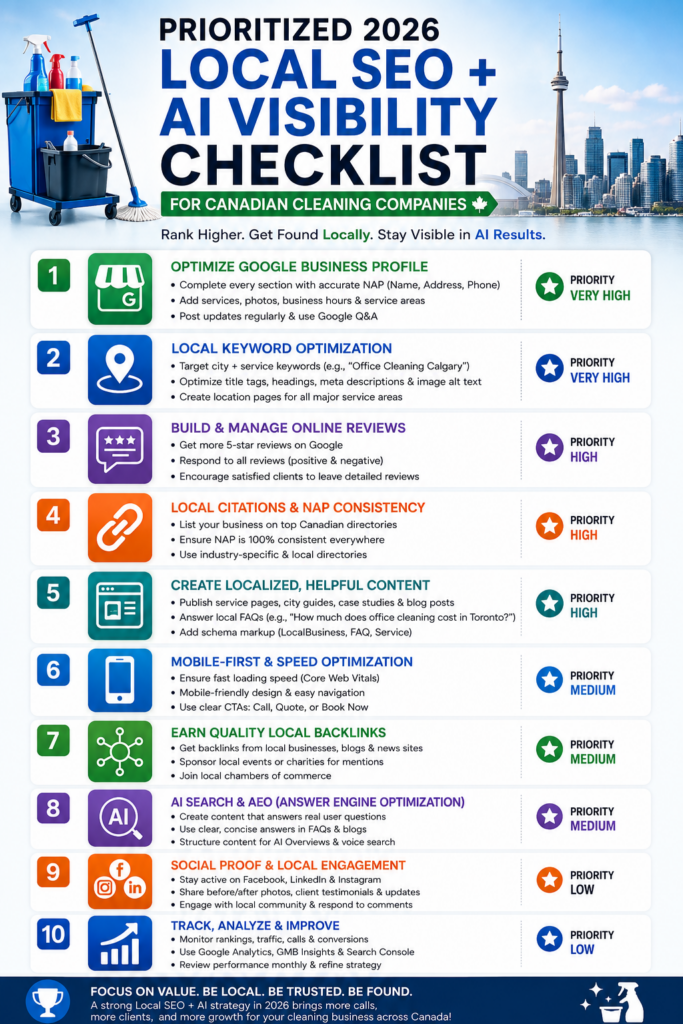
Prioritized 2026 Local SEO + AI Visibility Checklist for Canadian Cleaning Companies
The businesses that dominate local search in 2026 aren’t necessarily the biggest—they’re the ones with the strongest visibility systems. Instead of trying to tackle everything at once, focus on the highest-impact activities first.
Phase 1 (Weeks 1–2): Build a Strong Local SEO Foundation
These tasks have the greatest impact on both traditional search and AI visibility.
✓ Fully Optimize Your Google Business Profile
Treat your Google Business Profile (GBP) as your digital storefront—not a directory listing.
Ensure your profile includes:
- Primary category: Commercial Cleaning Service or the most relevant category
- Secondary categories (House Cleaning, Janitorial Service, Carpet Cleaning, etc.)
- Accurate service areas
- Business description written for users, not keywords
- Business hours
- Website URL
- Appointment or quote link
- Service listings
- Photos updated monthly
- Team images
- Branded vehicles
- Before-and-after cleaning photos
- Weekly Google Posts
Pro Tip: Upload real project photos from office cleaning, retail spaces, medical facilities, or warehouses. Authentic imagery builds more trust than stock photos.
✓ Standardize NAP Information Everywhere
NAP stands for:
- Name
- Address
- Phone Number
Your business information should match exactly across:
- Google Business Profile
- Website
- Bing Places
- Apple Business Connect
- Industry directories
- Chamber of Commerce listings
- Local business directories
Even small inconsistencies can reduce trust.
For example:
ABC Cleaning Ltd.
and
ABC Cleaning Limited
should be standardized wherever possible.
✓ Improve Core Web Vitals
Fast websites convert more visitors and provide a better user experience.
Focus on:
- Mobile loading speed
- Image optimization
- Fast hosting
- Reduced JavaScript
- Clean code
- Stable page layouts
- Responsive design
Technical performance won’t compensate for weak content, but poor performance can undermine strong content.
✓ Create Dedicated Service Pages
Avoid combining every service onto one generic page.
Instead, create individual pages for:
- Commercial Cleaning
- Office Cleaning
- Janitorial Services
- Medical Cleaning
- Industrial Cleaning
- Retail Cleaning
- Carpet Cleaning
- Window Cleaning
- Green Cleaning
Each page should answer:
- What the service includes
- Who it’s for
- Benefits
- Industries served
- Frequently asked questions
- Service process
- Local availability
Phase 2 (Weeks 3–6): Expand Local Authority
Once your foundation is in place, build topical authority across your service areas.
Create Location Pages
If you serve multiple cities, each should have its own optimized landing page.
Examples:
- Commercial Cleaning Toronto
- Janitorial Services Mississauga
- Office Cleaning Calgary
- House Cleaning Vancouver
- Industrial Cleaning Edmonton
Each location page should include:
- Local customer challenges
- Nearby neighbourhoods served
- Industries common in that city
- Client testimonials
- Original photography
- FAQs
- Internal links to related services
Avoid duplicate pages that simply swap city names.
Build Industry-Specific Pages
Cleaning businesses often work across many sectors.
Instead of speaking to everyone, create dedicated pages for:
- Medical Clinics
- Dental Offices
- Schools
- Daycares
- Warehouses
- Manufacturing Plants
- Retail Stores
- Restaurants
- Property Management Companies
- Condo Corporations
This demonstrates expertise and improves semantic relevance for highly specific searches.
Publish Helpful Educational Content
Instead of writing only promotional blogs, answer real customer questions.
Examples include:
- How Often Should an Office Be Professionally Cleaned?
- What Does Commercial Cleaning Include?
- Green Cleaning vs Traditional Cleaning
- Cleaning Requirements for Medical Clinics
- How to Prepare an Office Before Professional Cleaning
- How Much Does Commercial Cleaning Cost in Canada?
These articles naturally support both SEO and AI visibility because they provide structured, factual answers.
Phase 3 (Ongoing): Strengthen AI Visibility
Traditional SEO helps customers find you.
AI visibility helps answer engines recommend you.
Build Entity Consistency
AI systems look for consistent information across the web.
Ensure your business is represented consistently across:
- Website
- Google Business Profile
- Bing Places
- Apple Business Connect
- Industry directories
- News mentions
- Guest articles
- Local sponsorships
The more consistently your brand appears, the easier it is for AI systems to understand who you are and what you do.
Implement Structured Data
Every important page should include appropriate schema markup.
Recommended schema types:
- LocalBusiness
- Service
- FAQPage
- Article
- BreadcrumbList
- Organization
Schema won’t magically improve rankings, but it provides machine-readable context that supports both search engines and AI systems.
Create AI-Friendly Content
AI models prefer content that is:
- Well structured
- Clearly written
- Fact-based
- Easy to scan
- Broken into logical sections
- Rich with examples
Instead of long walls of text, use:
- Short paragraphs
- Numbered lists
- Tables
- Comparison charts
- FAQs
- Checklists
This makes your content easier for both people and machines to understand.
Common Local SEO Mistakes Canadian Cleaning Companies Still Make
Even experienced business owners often undermine their visibility with avoidable mistakes.
1. Treating Google Business Profile as “Set and Forget”
Google expects businesses to remain active.
Profiles that receive:
- New reviews
- Fresh photos
- Regular updates
- Updated services
- Google Posts
generally appear more trustworthy than inactive profiles.
2. Publishing Thin Location Pages
A 300-word page that replaces “Toronto” with “Vancouver” offers little value.
Instead, create genuinely local content that references:
- Local industries
- Neighbourhoods
- Building types
- Regulations where relevant
- Seasonal cleaning considerations
3. Chasing Keywords Instead of Topics
Modern search engines understand relationships between concepts.
Rather than repeating:
Commercial Cleaning Toronto
20 times, discuss:
- Office sanitation
- Facility maintenance
- Janitorial schedules
- Workplace hygiene
- Floor care
- Restroom disinfection
- High-touch surfaces
This aligns with the semantic SEO principles outlined in the Lumar Semantic Relevance report, which emphasizes optimizing for meaning and topical alignment rather than keyword repetition.
4. Ignoring Reviews After the First 20
Many companies stop requesting reviews once they reach a respectable rating.
Instead, build a consistent review acquisition process.
Aim for:
- Continuous review growth
- Detailed customer feedback
- Recent reviews
- Responses to every review
Review velocity often matters more than occasional bursts.
5. Publishing Generic AI Content
AI-generated content isn’t inherently bad.
Poor AI-generated content is.
Avoid publishing articles that:
- Repeat obvious advice
- Lack local examples
- Contain vague marketing language
- Show no operational experience
Instead, combine AI-assisted drafting with expert editing, real project examples, and practical insights.
How ROI Spectrum Helps Cleaning Companies Grow
At ROI Spectrum, we believe SEO should be measured by business outcomes—not vanity metrics.
That means focusing on:
- More qualified leads
- More booked estimates
- Higher-value commercial contracts
- Increased recurring revenue
- Better conversion rates
- Sustainable long-term visibility
Our Local SEO strategies combine:
- Google Business Profile optimization
- Local SEO
- Technical SEO
- Semantic content strategy
- AI visibility optimization (AEO & GEO)
- Conversion-focused website improvements
- Review generation systems
- Schema implementation
- Performance tracking
Rather than chasing every algorithm update, we build durable visibility systems designed to help service businesses earn trust across Google Search, Google Maps, and emerging AI-powered discovery platforms.
If you’d like to learn more, visit our Local SEO Services page:
Or request a Free Local SEO Audit to identify your biggest growth opportunities.
Final Thoughts
The future of local search isn’t about replacing SEO with AI.
It’s about combining proven local SEO fundamentals with the signals AI systems increasingly rely on.
For Canadian cleaning companies, success in 2026 comes from building a trusted digital presence that consistently demonstrates:
- Experience through real project examples
- Expertise through helpful educational content
- Authority through strong local signals
- Trust through reviews, transparency, and accurate business information
Businesses that invest in these fundamentals won’t just rank better—they’ll become easier for Google, AI assistants, and prospective customers to recommend.
Remember that AI visibility is still evolving. While optimization techniques can improve the likelihood of being referenced by AI-powered search experiences, no agency can guarantee inclusion in AI-generated answers. Likewise, traditional local search remains highly resilient for transactional queries such as “commercial cleaning near me” or “house cleaners in Toronto.” A balanced strategy that strengthens Maps, organic search, and AI discoverability offers the most sustainable path to growth.
If your goal is more phone calls, more quote requests, and more recurring cleaning contracts, now is the time to build a visibility strategy that works across both traditional search and AI-powered discovery.
Frequently Asked Questions
What is local SEO for cleaning companies?
Local SEO helps cleaning businesses appear in Google Search and Google Maps when people search for services in specific locations. It includes Google Business Profile optimization, location pages, reviews, citations, and locally relevant content.
Can ChatGPT or Google AI recommend my cleaning business?
Yes. AI platforms may reference businesses that have strong online authority, consistent business information, helpful content, positive reviews, and credible web mentions. However, inclusion is not guaranteed and AI visibility continues to evolve.
Is Google Business Profile still important in 2026?
Absolutely. For most cleaning companies, Google Business Profile remains one of the most important sources of local visibility, phone calls, and direction requests.
What schema should a cleaning company use?
Most cleaning businesses should consider implementing LocalBusiness, Service, FAQPage, Organization, BreadcrumbList, and Article schema where appropriate to help search engines better understand their website.
How often should I ask customers for reviews?
Review collection should be an ongoing process. Request feedback after successful jobs and encourage customers to leave detailed reviews describing the services provided and their experience.
What’s the difference between SEO and AI Visibility?
SEO focuses on improving rankings in search engines, while AI visibility aims to increase the likelihood that AI-powered search experiences reference or recommend your business. In practice, strong SEO fundamentals support both.